Medical Team Meetings
Utilising Technology to Enhance Communication, Collaboration and Decision-Making
Medical Team Meetings
Utilising Technology to Enhance Communication, Collaboration and Decision-Making

CFP: Special Issue of Behaviour and Information Technology
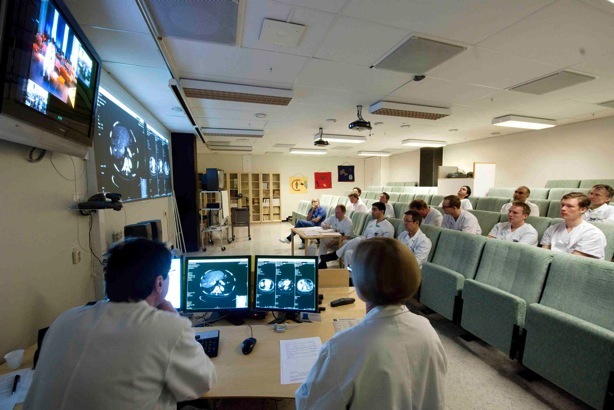
Photograph: Staffan Larsson (STH, KTH), used with permission
GUEST EDITORS
Bridget Kane PhD
Trinity College Dublin, Ireland
Kristina Groth PhD
KTH and Karolinska Institutet
Stockholm, Sweden
Dave Randall PhD
Manchester Metropolitan University
United Kingdom
EDITORIAL BOARD
Clive Griffith MB ChB
National Clinical Advisor on Breast Cancer
NHS.Improvement-Cancer, United Kingdom
Gunnar Hartvigsen, Professor
Department of Computer Science
University of Tromsø, Norway, and
Norwegian Centre for Integrated Care and Telemedicine
Saturnino Luz, PhD
Dept of Computer Science
Trinity College Dublin, Ireland
Per Måseide, PhD
Professor in Sociology
Faculty of Social Sciences
Bodø University College, Norway
Ken O'Byrne MB BCh
Clinical Professor of Oncology
St James's Hospital and
School of Medicine - Haematology and Oncology
Trinity College Dublin, Ireland
Mick Peake MB ChB
National Clinical Lead,
NHS Cancer Improvement and Clinical Lead
National Intelligence Network, United Kingdom
Johan Permert, PhD
Professor of Surgery
Karolinska Institutet
and head of the Gastro Enterology Department
Karolinska University Hospital, Sweden
Madhu Reddy, PhD
College of Information Sciences and Technology
The Pennsylvania State University, U.S.A.
Di Riley, MSc
Associate Director for Clinical Outcomes
National Cancer Intelligence Network, UK
Jeremiah Scholl, PhD
Norwegian Centre for Integrated Care and Telemedicine
Tromsø, Norway
Eva-Lotta Sallnäs, PhD
Dept. of Human-Computer Interaction
School of Computer Science and Communication
Royal Institute of Technology, Sweden
Charlotte Tang, PhD
Department of Community Health Sciences
Faculty of Medicine
University of Calgary, Canada
Pieter Toussaint PhD
Associate Professor
NTNU and NSEP
Trondheim, Norway
Stephanie Wilson, PhD
Centre for HCI Design
City University London, UK
KEY DATES
Paper Submission:
May 15 2010
Final Decision:
July 30 2010
Submission of Revised Papers:
Sept 30 2010
Submission of Revised Papers:
Oct 29 2010
Publication date early 2011
RESOURCES
GENERAL ENQUIRIES
may be directed to
Today, it has become common practice that a team of clinicians, instead of a single doctor, manages the care of an individual patient (i.e. team-based treatment). This is especially true in complex or difficult cases, when decisions are being made. For example, when determining the disease stage in a cancer patient, or when planning a treatment strategy that involves concurrent or sequential treatments of different modalities (chemotherapy, radiation therapy or surgery) several specialities are involved and synchronous interaction among these professionals in a multidisciplinary team (MDT) is preferred.
Typically this change in healthcare work practice, from a single clinician to a group of clinicians managing a patient, has resulted in the development of team meetings. Team meetings, and interdisciplinary/multidisciplinary team meetings (MDTMs) in particular, tend to have a specific set of characteristics regardless of the individual patient, the disease being discussed, or the types of treatment being considered (Måseide, 2006). Such interdisciplinary/multidisciplinary team meetings are being recommended (Calman and Hine, 1995), and have been described, in Europe, Australia and North America, particularly in publically funded healthcare systems and/or large teaching centres (Groth et al., Kane and Luz, 2009). Furthermore, as healthcare continues to become more centralised and specialised, communication technology is being deployed to enable multidisciplinary team (MDT) services to be provided over large geographical areas (Li et al., 2008).
These developments raise a host of issues: How are different roles, a range of expertise and specialised knowledge bases integrated? What kind of technologies are needed and/or available? How can technology be employed to support or enhance the communication and functions of meetings? Are there particular requirements for video-mediated communication, or other I.T. based solutions, in such settings? What difference, if any, does co-location make to practice? The major focus in this special issue is on the particular problems faced in multidisciplinary team meetings in clinical domains, and the solutions offered to address these problems.
This special issue aims to bring together papers that explore the intersection between researchers focusing on, and practitioners working within, the health care sector, with an interest in different aspects of meeting processes in clinical domains. Our aim is to explicate the issues and identify how technology can be employed to improve the effectiveness of meetings. The following are suggested, but not exclusive themes. Our interest is in papers that address issues that may relate to preparation for MDTMs, communication during meetings, record keeping and/or follow-up on meeting decisions. We are also interested in the transfer of responsibility for patient care between individual specialists, and/or between different teams (co-located or technology mediated). Reports on studies conducted in ward settings or analogous meetings among clinicians that involve these topics are also welcomed.
We encourage a broad range of contributions that are both from a technical and a social perspective, but the domain of work should be within health care.
Suggested topics include:
-collaboration issues (how information is shared during medical team meetings / MDTMs, and how team work is performed etc.)
-technology supporting collaboration (using for example multi-modal interfaces, information visualisation, and haptics to support different interaction forms during MDTMs)
-mediated communication (including using video conference technology and mobile systems)
-record keeping (for example information and decision capture at MDTMs)
-methods to identify design issues, conduct evaluations, development and deployment
-methodological issues (e.g. regarding collaboration between developers and procurement)
-costs, economic and policy issues
EXPRESSIONS OF INTEREST
The Guest editors appreciate expressions of interest (EoI) as they help to plan the review cycle and allocation.
EoIs can range from a one paragraph through to a two-page position statement like submission.
These can be sent to
any time before the paper submission deadline
SUBMISSIONS
Manuscripts (up to 18 pages) should be prepared according to the
Journal of Behaviour and Information Technology (BIT) requirements and submitted via the on-line system.
BIT provides extensive instructions for authors,
which can be found at:
Submission is through the standard BIT website.
All submissions should be submitted as being for the Special Issue on “Medical Team Meetings: Utilising Technology to
Enhance Communication, Collaboration and Decision-Making”.
Submissions should be no longer than 18 pages, to include Figures and Tables. All papers will be blind reviewed.
REFERENCES
CALMAN, K. & HINE, D. 1995. A Policy Framework for Commissioning Cancer Services. In: HEALTH, D. O. (ed.). Cardiff: Welsh Office.
GROTH, K., OLIN, K., GRAN, O. & PERMERT, J. The role of technology in video-mediated consensus meetings. Journal of telemedicine and e-health, 14, 349-353.
KANE, B. & LUZ, S. 2009. Achieving Diagnosis by Consensus. Computer Supported Cooperative Work (CSCW), 18, 357 - 392.
LI, J., MANSFIELD, T. & HANSEN, S. Year. Supporting Enhanced Collaboration in Distributed Multidisciplinary Care Team Meetings. In: 21st IEEE International Symposium on Computer-Based Medical Systems, 17-19 June 2008 2008 Jyväskylä, Finland. IEEE, 482-487.
MÅSEIDE, P. 2006. The deep play of medicine: Discursive and collaborative processing of evidence in medical problem solving. Communication & Medicine, 3, 43-54.
Introduction